Multiple Pathways to Urban Density
Cities don't simply become denser. They follow distinct densification pathways through transitions between building types. A diachronic analysis across New York, Melbourne and Barcelona identifies seven building types and three fundamental pathways to density over two centuries.
Tumturk, O. (2025). Multiple Pathways to Urban Density. Cities, 167, 106308. https://doi.org/10.1016/j.cities.2025.106308
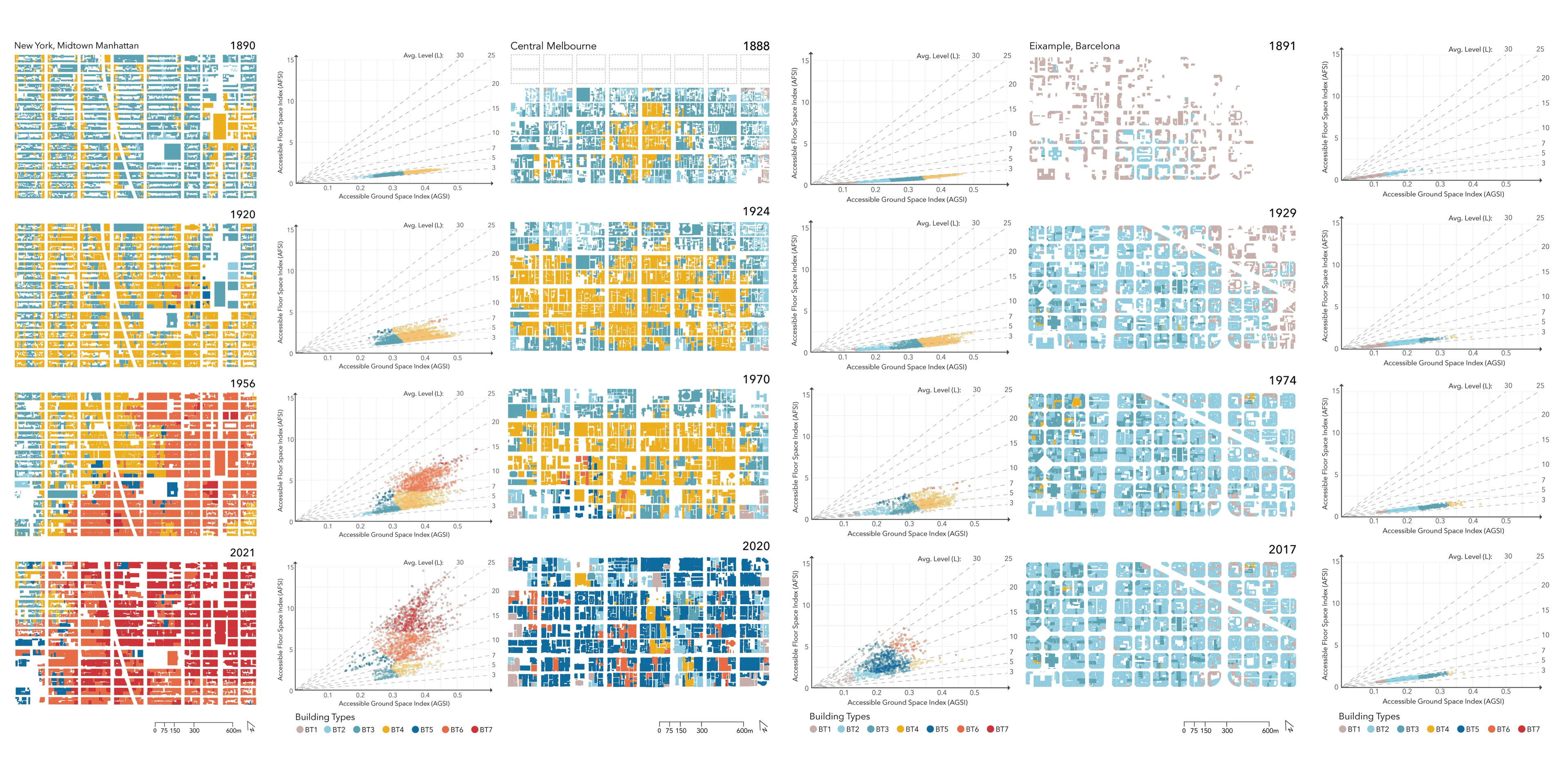
The same density can be achieved through radically different building configurations. A 30-storey tower with setbacks and a 6-storey perimeter block can produce identical floor area ratios while creating entirely different urban environments. This is well established. What remains unexplored is how these different configurations emerge and transition over time. This paper presents one of the first attempts to operationalize Spacemate, the influential multi-variable density framework, in diachronic terms. Rather than asking where cities sit in the density spectrum, I ask how they move through it.
Operationalizing Spacemate in Diachronic Terms
Drawing on a longitudinal morphological database I developed during my PhD research, I examined three city centers across nearly two centuries: New York's Midtown, Melbourne's CBD, and Barcelona's Eixample (1800s to 2020s). These cities share a common origin in nineteenth-century grid plans with uniform plots, yet today they exhibit dramatically different morphological characters. Combining this dataset with hierarchical clustering on accessible density measures, I identified seven distinct building types ranging from mid-rise open configurations to extra high-rise compact developments. The diachronic Spacemate approach allowed me to track how these types emerge, persist, and transform across time, capturing dynamics that synchronic studies miss entirely.
Three Cities, Three Densification Pathways
What this dataset makes visible is that cities don't simply become denser. They follow distinct pathways through specific sequences of building type transitions. Compact densification fills available ground space while maintaining building heights: Barcelona's story, where mid-rise perimeter blocks gradually completed over a century, preserving Cerdà's vision. Vertical densification increases height while preserving ground coverage: New York's dramatic skyward growth from 4-storey walk-ups to 30-storey towers, maintaining continuous street walls and high compactness throughout. Dispersed densification builds taller but reduces ground coverage: Melbourne's recent transformation, where high-rises replaced compact fabric but with setbacks that eroded street frontages and produced a sparser streetscape despite significant vertical growth.
Why the Pathway You Choose Determines Urban Character
Each pathway achieves density through different building type transitions, producing distinct conditions for street life, open space, and urban character. Understanding these pathways allows planners to anticipate the morphological consequences of density policies, moving beyond simplistic floor area ratios to strategically guide building type transitions that align with desired urban qualities.