The Grounded Projection: Urban Design Pedagogy at MSD
A reflective examination of how three sequential design studios at the University of Melbourne systematically integrate analytical rigour with speculative imagination, using the city as a living laboratory for urban design education.
Tumturk, O., Karakiewicz, J., Villoria, L.A., and Mah, D. (2025). The Grounded Projection: Urban Design Pedagogy at MSD. Journal of Design for Resilience in Architecture & Planning, 6, 97-132. https://doi.org/10.47818/DRArch.2025.v6si197
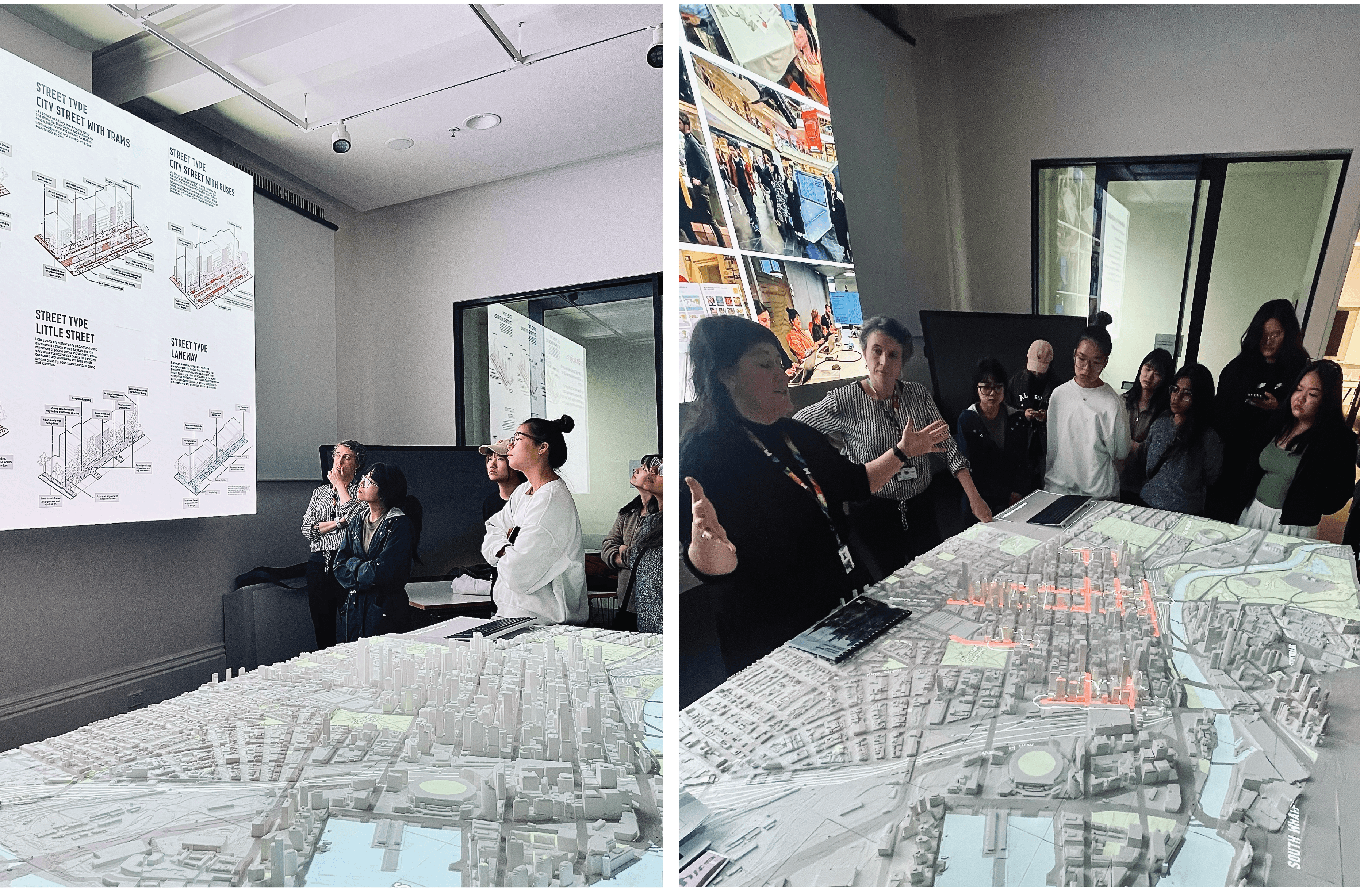
After years of co-teaching urban design studios together at Melbourne School of Design, my colleagues Justyna Karakiewicz, Leire Asensio Villoria, David Mah and I finally sat down to articulate what we had been doing all along. What emerged from our reflection was a framework we call grounded projection: the understanding that deep analytical knowledge does not constrain speculative imagination but actually enables it. Students equipped with morphological, parametric, and rule-based analytical tools early in the program go on to produce more radical, more credible visions of urban futures in their later studios.
Understanding First, Speculating Later: Four Studio Sequence at MSD
Rather than documenting isolated studio experiences, the paper examines how four sequential studios build capabilities systematically across a complete two-year degree. Studio A establishes rule-based design thinking through intensive engagement with urban morphology and multi-dimensional performance evaluation. Studio B applies these analytical tools to social and political dimensions through industry partnerships. Studio C extends temporal horizons to 75-100 year frameworks for climate-adapted futures. The thesis studio synthesises everything through self-directed research balancing individual expertise with collaborative urban frameworks.
What Grounded Projection Produces
The paper is richly illustrated with student projects from multiple cohorts, each showing how analytical rigour and speculative ambition operate together rather than in tension. One cohort traced ecological restoration strategies across Fishermans Bend spanning 2025-2100. Another reimagined Melbourne's bridge infrastructure as living, adaptive systems integrating with restored ecologies. Readers will find in these projects the clearest evidence for what the grounded projection framework actually produces. Melbourne's role as a continuous living laboratory across all four semesters runs through all of them.
Analytical Foundations Enable Imaginative Capacity
The paper positions MSD's approach within international pedagogical discourse, showing how normative, pragmatic and exploratory pedagogies can integrate sequentially rather than competing as alternative models. For programs grappling with how to prepare urban designers for challenges that exceed conventional planning horizons, this offers one pathway: not a template, but evidence that analytical foundations enable rather than constrain imaginative capacity.
This paper is part of the special issue Pedagogies in Urban Design: Broadening the Perspective, edited by Irmak Yavuz Özgür and Olgu Çalışkan, a carefully curated collection of perspectives on urban design education from around the world that is worth a look in its own right.