Empirical Test of Whitehand's Neighbour Effect Hypothesis
The first empirical test of one of urban morphology's most overlooked hypotheses, demonstrating that the propensity for change or persistence comes from the mutual support between neighbouring plots rather than their individual character.
Tumturk, O. (2025). Empirical Test of Whitehand's Neighbour Effect Hypothesis. Urban Morphology, 29(1), 23-43. https://doi.org/10.51347/UM29.0002
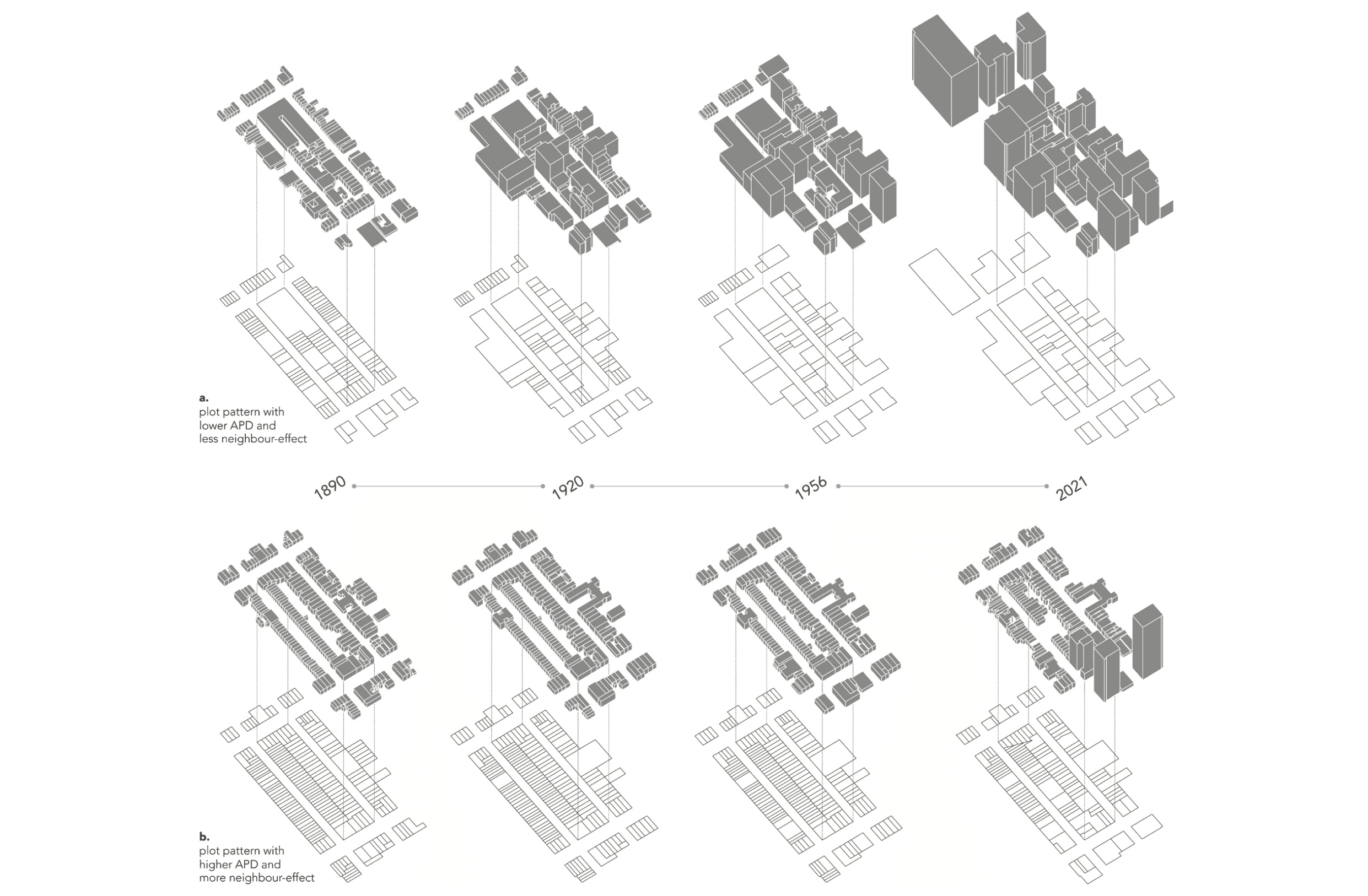
Whitehand's neighbour effect hypothesis suggests that urban change does not happen plot by plot in isolation. It spreads contagiously through mutual relationships between neighbouring properties. He developed this idea studying small-scale cosmetic alterations in British suburbs during the 1990s, observing how façade changes and garden modifications cluster and diffuse among neighbours. But he also hypothesised something he never tested: that large-scale changes like building demolition would follow the inverse pattern, resisting change in fine-grained areas where plots provide mutual support to one another. This paper provides the first quantitative empirical test of that hypothesis.
Testing the Hypothesis in Manhattan Across 130 Years
Whitehand's original work focused on incremental cosmetic changes in slow-changing residential neighbourhoods. I wanted to test whether his hypothesis about large-scale change holds in a completely different context: Midtown Manhattan, one of the most dynamic urban environments on earth, across 130 years of transformation. The challenge was operationalising what Whitehand described qualitatively, the "mutual support" between neighbouring plots, into something measurable.
The Mutual Support Between Neighbours
Recent advances in quantitative urban morphology offered a solution: access-based measures of urban form that describe not what an individual plot looks like, but what kind of plot pattern surrounds it within walking distance. These measures quantify exactly what Whitehand intuited: the degree of mutual support a plot receives from its neighbours.
Across all three analysis periods spanning 1890 to 2021, access-based measures showed consistent relationships with building replacement. Fine-grained plot patterns resisted change; coarse-grained patterns experienced more demolition. Individual plot size, by contrast, showed erratic relationships, positive in one period, negative in another, insignificant in a third. What drives change is not the plot itself but the mutual interaction between elements.
From Individual Elements to Relational Patterns
The results provide the first quantitative support for Whitehand's neighbour effect hypothesis regarding large-scale physical change. The key shift is methodological: from measuring individual morphological elements to measuring the relational patterns they form together. Urban change, it turns out, is a collective phenomenon, and understanding it requires looking at the neighbourhood, not just the parcel.