Measuring the Impact of Plot Types on Physical Change
A diachronic analysis across New York, Melbourne and Barcelona revealing that finer-grained, narrower plot types resist building replacement while coarser-grained types facilitate transformation, using configurational clustering over nearly two centuries.
Tumturk, O., Karakiewicz, J., and Haan, F.J.D. (2024). Measuring the Impact of Plot Types on Physical Change. Cities, 154, 105380. https://doi.org/10.1016/j.cities.2024.105380
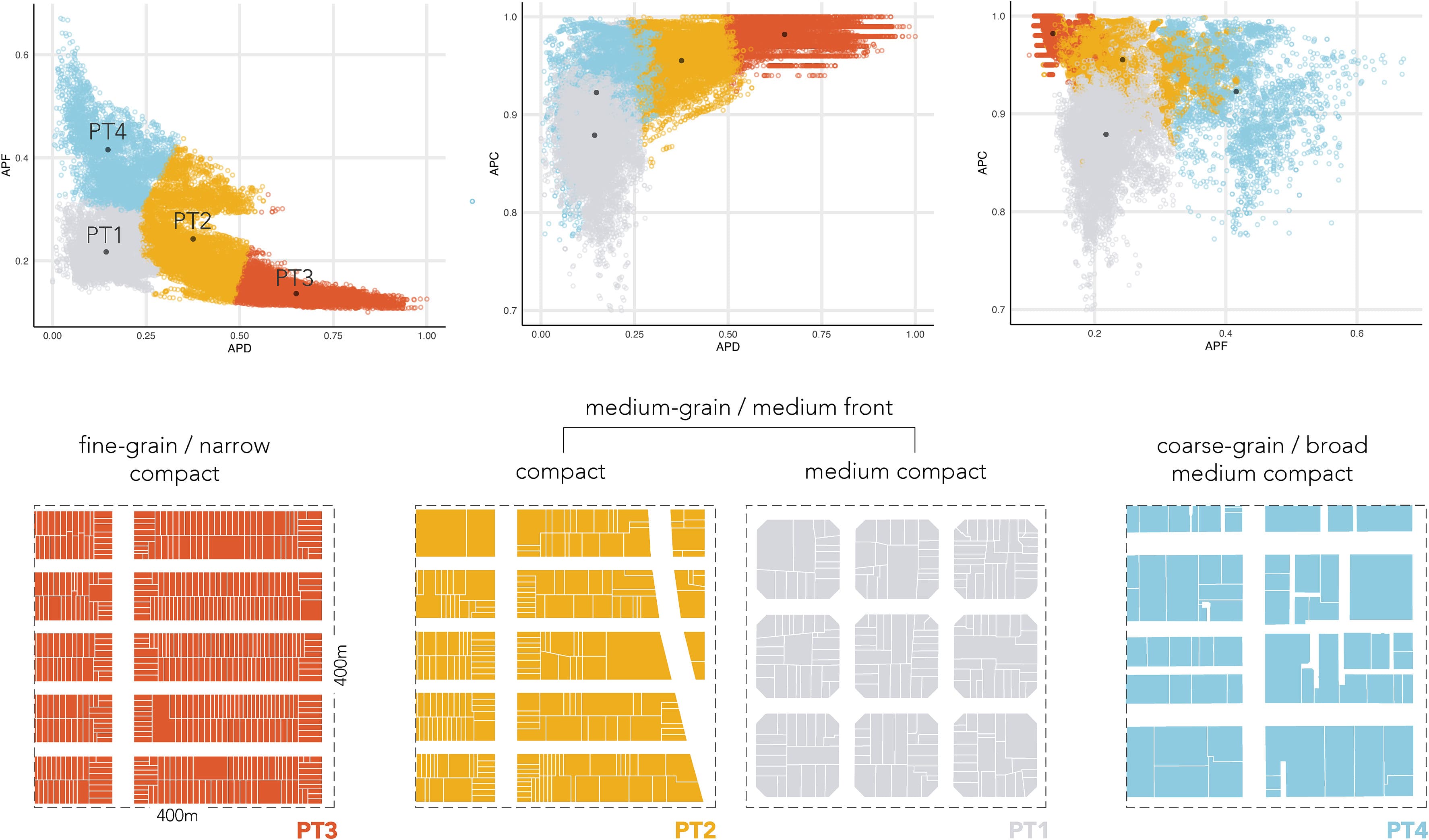
Plots are widely considered the most influential determinant of how cities evolve, yet they remain the least studied element of urban form. The handful of diachronic studies that exist are primarily qualitative, and the quantitative work that has emerged tends to stay synchronic, capturing cities at a single moment. We wanted to know whether the relationship between plot types and physical change could be measured rigorously, across different cities and different time periods, and whether that measurement could move beyond the familiar claims about small plots persisting and large plots changing.
Building Plot Typologies Across Three Cities and Two Centuries
We built longitudinal databases for New York, Melbourne, and Barcelona, each covering four time periods from the late 1800s to the 2020s. Rather than relying on individual plot size and shape, the conventional approach, we used configurational variables that describe the character of the plot pattern within a 400-meter walkable catchment. How many plots can you reach? What is the cumulative frontage pattern? How regular are the surrounding subdivisions? K-means clustering on these variables identified four distinct plot types: from fine-grained, narrow, and compact at one end to coarse-grained, broad, and irregular at the other.
Fine-Grained Plots Resist Change While Coarse-Grained Plots Transform Faster
The pattern holds across all three cities and all four time periods. Fine-grained plot types showed substantially lower rates of building replacement than their coarse-grained counterparts: roughly 30% versus 45%, a gap that is consistent and meaningful. New York and Melbourne gradually shed their fine-grained structures over the study period, while Barcelona maintained its plot configuration almost unchanged across a century. The type of plot pattern a neighbourhood has inherited shapes how it changes, decades later.
Relational Plot Structure Matters More Than Individual Plot Size
The core finding is not simply that smaller plots persist. It is that the character of the surrounding plot pattern matters more than any individual parcel taken in isolation. A small plot embedded in a fine-grained structure behaves differently from a small plot surrounded by amalgamated land. Distributed ownership across many narrow frontages creates a form of collective resistance to redevelopment that no single parcel can generate on its own. Relational dynamics, not individual geometry, explain why some urban fabrics endure while others transform. The neighbour effect paper takes this further, testing how the mutual support between neighbouring plots drives or resists large-scale physical change.