The Impact of Urban Form on Physical Change: Midtown Manhattan
A quantitative and diachronic analysis proving that configurational measures of plots and streets outperform conventional geometric measures in explaining why some blocks get rebuilt while others persist for over a century.
Tumturk, O., Karakiewicz, J., and Haan, F.J.D. (2024). The Impact of Urban Form on Physical Change: Midtown Manhattan. EPB: Urban Analytics and City Science, 52(5), 1035-1054. https://doi.org/10.1177/23998083241272096
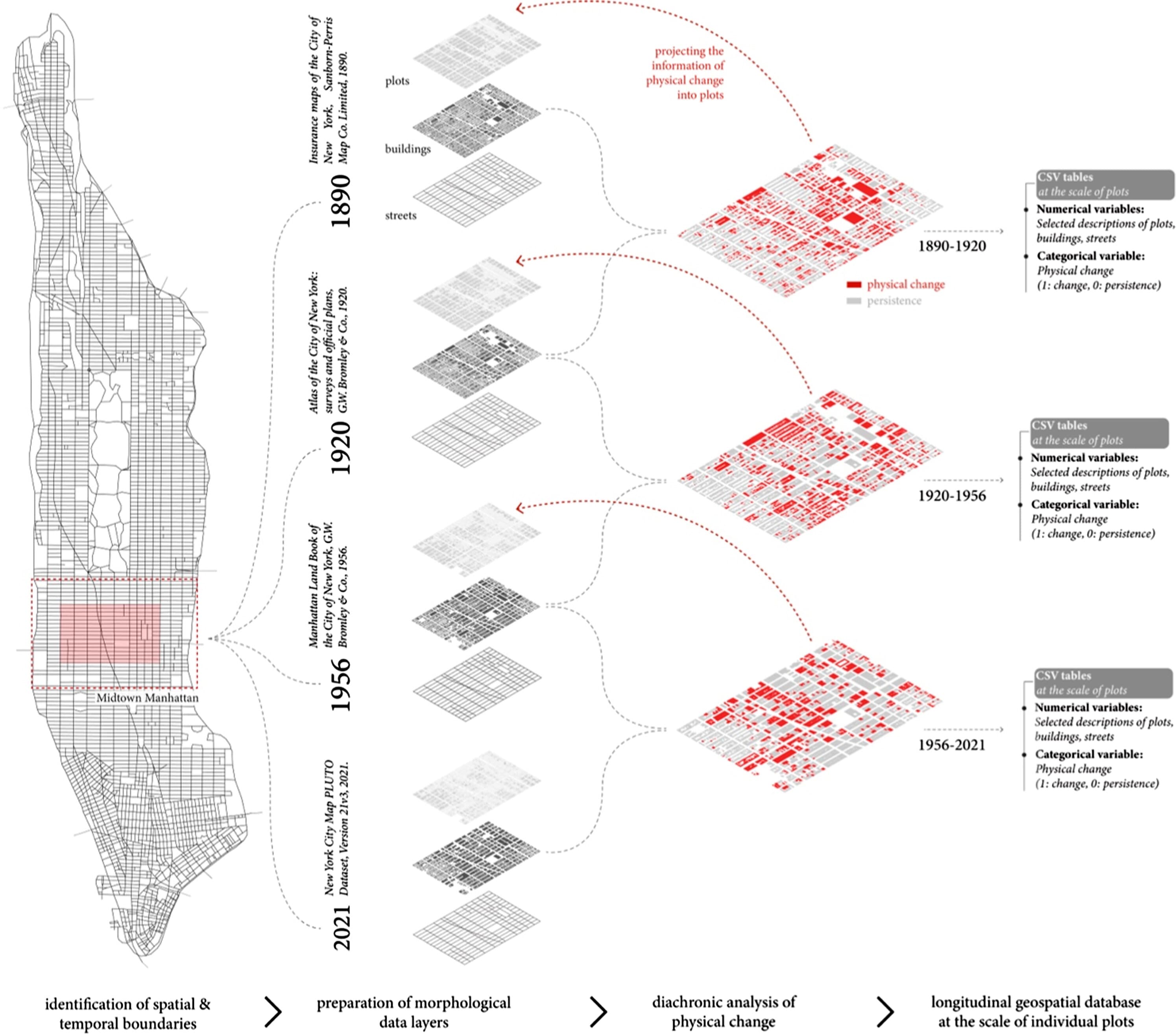
This paper was the first empirical output of my PhD research, and it set the terms for everything that followed. The core question was simple: does the physical form of a city actually influence how it changes over time? Urban morphologists had been arguing that it does for decades, with plot sizes, street patterns, and building densities cast as conditions that constrain or enable future transformation. But these arguments had rarely been tested with quantitative longitudinal data, and almost never in a high-density, high-turnover environment. Midtown Manhattan over 130 years seemed like the right place to find out.
Geometric Versus Configurational: A Direct Comparison
The standard approach in morphological research focuses on individual elements: plot size, plot shape, building footprint. The assumption is that smaller plots persist because amalgamation is costly, and narrow frontages resist change. These intuitions come almost entirely from low-density suburban studies. We built a longitudinal database from historical maps (1890, 1920, 1956) and contemporary data (2021), tracking every plot, building, and street segment across four periods, and then tested whether these conventional geometric measures actually predict physical change, or whether configurational variables that describe the surrounding plot pattern do better.
Geometry Fails, but Pattern Prevails
Geometric measures showed inconsistent results across periods. Individual plot size was an unreliable predictor, positive in one period, negative in another, insignificant in a third. Configurational measures worked consistently. The density of plots accessible within a 400-meter catchment predicted physical change in every period: fine-grained surroundings were associated with persistence, coarse-grained ones with transformation.
Street centrality followed expected patterns, with one notable historical exception: elevated railways suppressed redevelopment along otherwise central corridors between 1890 and 1920. Once demolished, those same corridors transformed rapidly. Built density added a further dimension, with underexploited areas changing more frequently than those already built to capacity.
The Starting Point of a Larger Inquiry
The results established something the field had largely assumed but not demonstrated: that urban form measurably influences physical change, and that configurational measures are better suited to capturing this than conventional geometric ones. Midtown Manhattan served as a stress test. Subsequent work extended these findings to multiple cities, longer timescales, and more specific hypotheses about what drives urban transformation.