Building the Open City: Learning Through Piecemeal Experimentation in Melbourne
A book chapter on what Karl Popper's open society means for cities, and how Melbourne learned its way out of decline.
Tumturk, O. (2026). Building the Open City: Learning Through Piecemeal Experimentation in Melbourne. In A. De Franco & S. Cozzolino (Eds.), The Open City and its Allies: Urban Planning Ethics in Practice (pp. 79–104). Palgrave Macmillan. https://doi.org/10.1007/978-981-92-3722-7_5
Karl Popper's The Open Society and Its Enemies is one of the books that changed how I think. I did not read it as a book about cities, and it is not one. But its central argument stayed with me: a society is open not because it has found the right answers, but because it has built the means to discover that it is wrong and to correct itself. Since my graduate studies, I have been drawn to the ideas that sit close to that argument: adaptability, flexibility, complexity, emergence. Openness is the word I would now use for what connects them, and I have pursued it in different forms ever since.
So when Anita De Franco and Stefano Cozzolino invited me to contribute to The Open City and its Allies: Urban Planning Ethics in Practice (Palgrave Macmillan, 2026), it was an invitation to go back to the source. The book starts from an honest observation: the "open city" is widely celebrated but rarely specified. Its title is a deliberate echo of Popper, and it brings together planners, designers, a political philosopher and an economist to ask what openness in cities actually means, where its limits are, and why closure remains so tempting.
The Allure of Closed Systems
Planning has always felt the pull of the closed system. The comprehensive plan and the finished blueprint promise order, certainty and a city that finally holds still. Popper called this utopian social engineering, and his objection was practical as much as moral. When everything is changed at once, nobody can tell which change produced which result. Large schemes therefore cannot learn, and they tend to drift into constant improvisation that contradicts the original vision.
His alternative was piecemeal social engineering: small adjustments that can be tested, criticised and improved. He saw experiments everywhere in ordinary life: "Even a man who opens a new shop, or who reserves a ticket for the theatre, is carrying out a kind of social experiment on a small scale."
Openness as a Capacity to Learn
My chapter takes this literally. I argue that urban openness is a city's institutional capacity to experiment and to learn from the results, and I propose a 3P Learning Framework to describe it: practical learning (finding out what works), political learning (changing what stakeholders believe is possible) and process learning (embedding experimentation in institutions so that it outlasts individual projects).
Melbourne as a Learning City
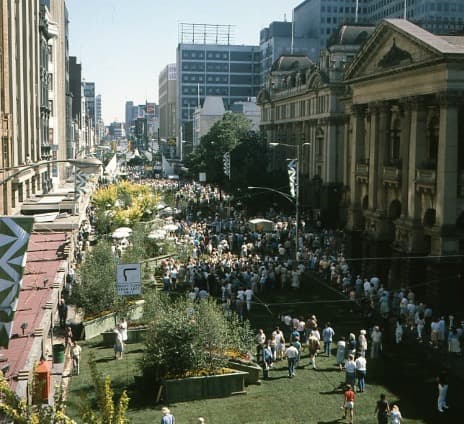
I test the framework on central Melbourne, a city I know well from my doctoral years. Its recovery from a business district that emptied after office hours did not come from a grand project but from decades of small moves. Postcode 3000 brought residents back by proving the case with a handful of building conversions, after an earlier incentive scheme had failed. A single weekend in 1985, when Swanston Street was closed to traffic and covered in grass, made its later pedestrianisation thinkable. And pilot projects, monitored with Jan Gehl's public life surveys, took the active laneways from 300 metres to 3.43 kilometres in a decade.
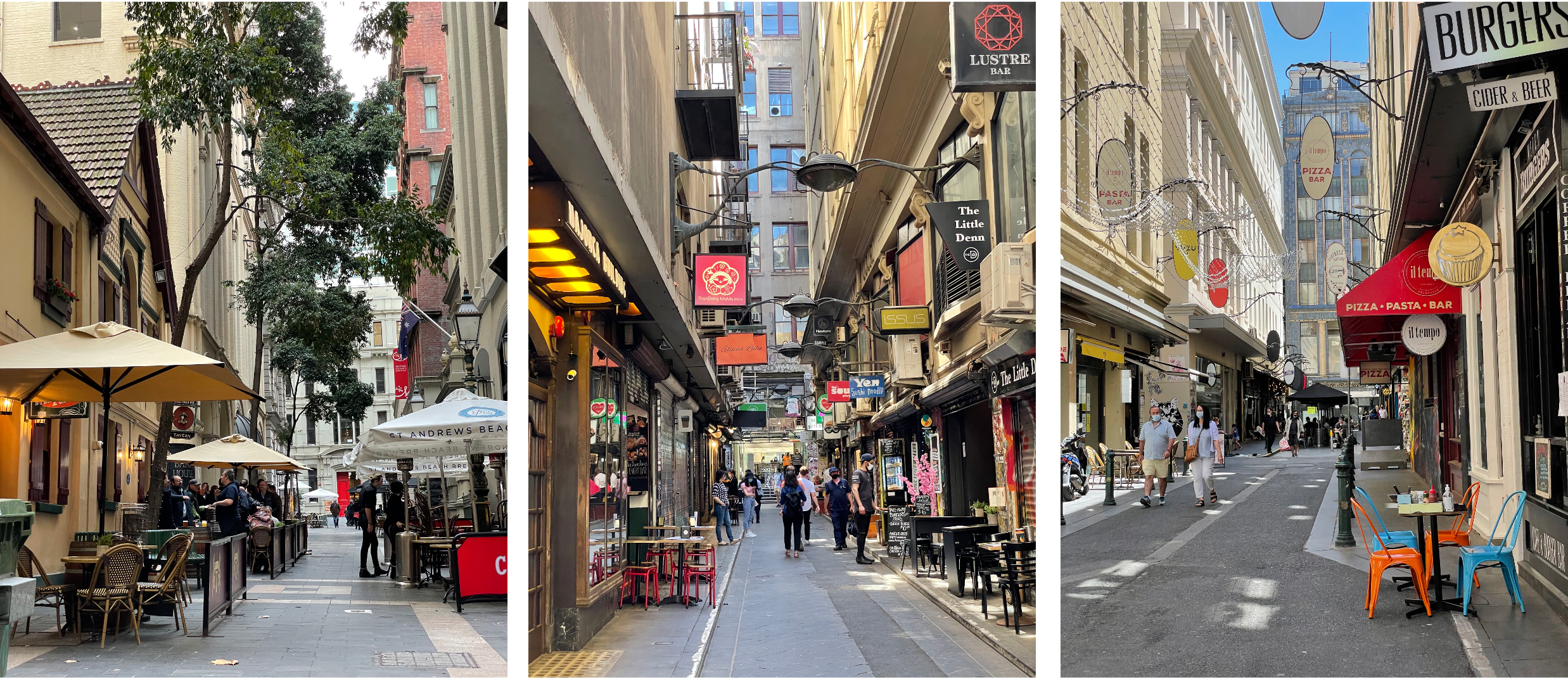
What I take from it is that openness and experimentation feed each other, and that Melbourne's skill lay in recognising patterns that emerged from below and reinforcing them from above. The chapter also records the costs, from the lack of affordable housing to laneways built only to collect a bonus. An experimental city still has to ask whose openness it is serving.
The Book
The volume is open access, and I am grateful to Anita De Franco and Stefano Cozzolino for the invitation and for their work as editors. It grew out of the AESOP thematic group on Ethics and Justice, and includes chapters by Stefano Moroni and Ian Carter, David Emanuel Andersson, Stefano Cozzolino, Elena Porqueddu, Nurit Alfasi and Anita De Franco.