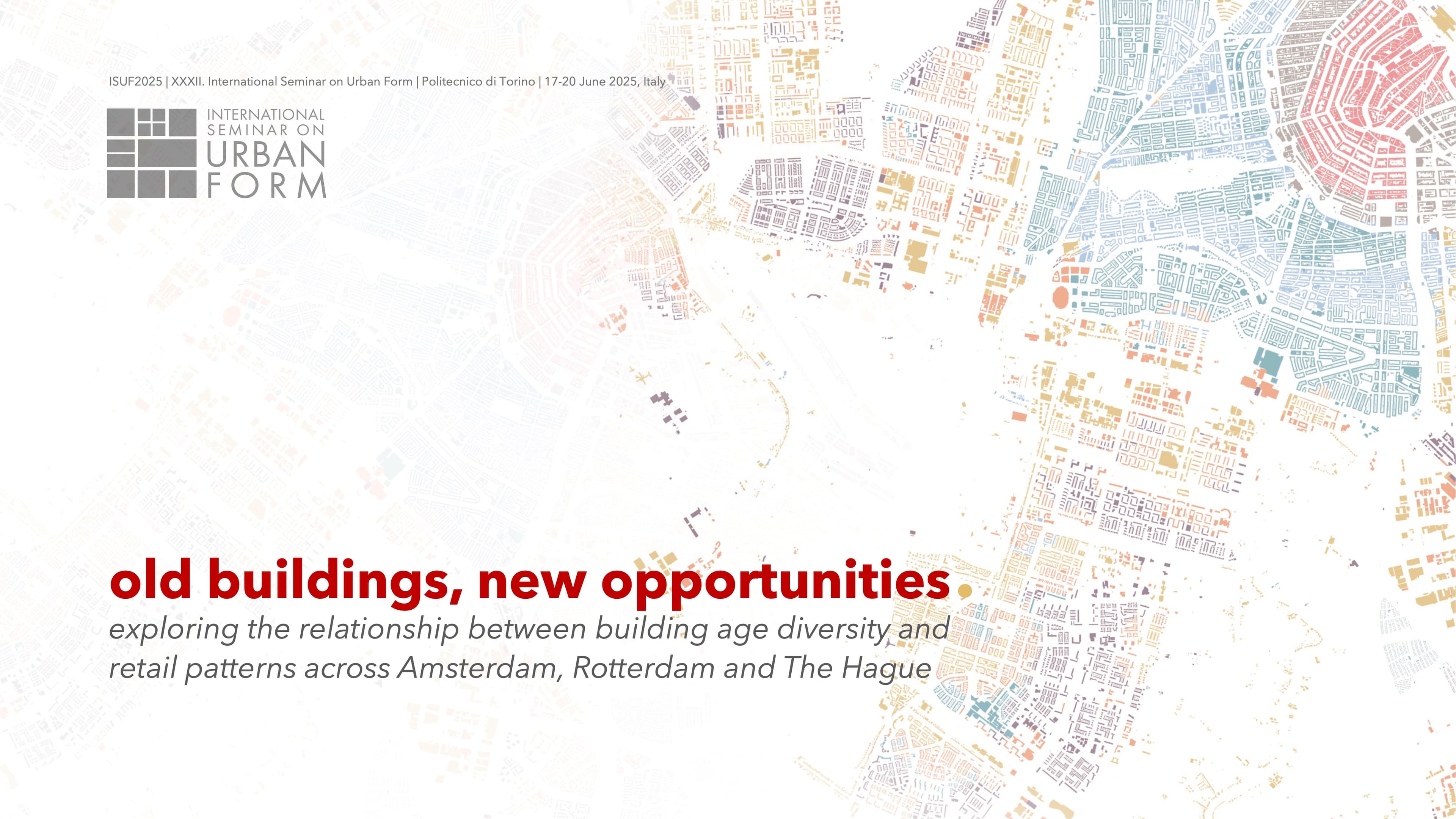
A lot of my PhD work dealt with the time dimension of urban form: how cities change physically over decades and centuries, and how painfully difficult it is to collect the longitudinal data needed to study that properly. I kept thinking about whether there was a more operational way to quantify the degree to which an area developed incrementally versus all at once. Some basic, readable signal of how a place has experienced time.
Jane Jacobs saved me, as usual. Every time I go back to The Death and Life of Great American Cities I find something I had missed before. This time it was her fourth condition for urban diversity: buildings that vary in age and condition. Unlike mixed uses, small blocks, or density, building age diversity cannot be designed into existence. It accumulates. It is a direct imprint of how incrementally or suddenly a place was built. That sounded exactly like the concept I was looking for.
The paper came together with three close friends and colleagues: Eren Efeoğlu, Mert Akay, and Olgu Çalışkan. We examined roughly 700,000 buildings across Amsterdam, Rotterdam, and The Hague, looking at how building age patterns relate to the intensity and diversity of retail activity in accessible reach. One of the things we developed along the way is a basic evaluation tool we call the Temporal Fingerprint Matrix, which allows assessing and differentiating the temporal character of urban form in a practical, readable way.
We presented the work at ISUF 2025, the 32nd International Seminar on Urban Form in Turin, under the theme "Urban Morphology in the Age of Artificial Intelligence." A full journal paper is currently under review and should be out, hopefully, soon.
Update: and yes, it is finally out, in Urban Studies. We also put together an interactive companion to it, if you would rather scroll through the argument than read it: the Temporal Fingerprint Matrix.